
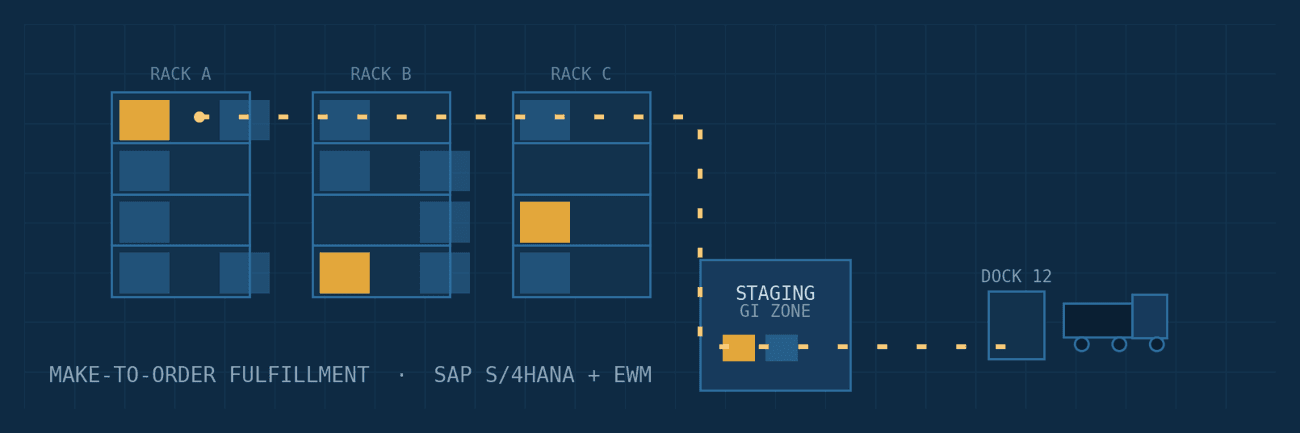
From the moment a customer confirms a sales order to the moment a Handling Unit leaves the dock, every step has to stay traceable to that one order. Here's how SAP S/4HANA and SAP EWM make that possible.
A GUIDE · SD · PP · EWM INTEGRATION
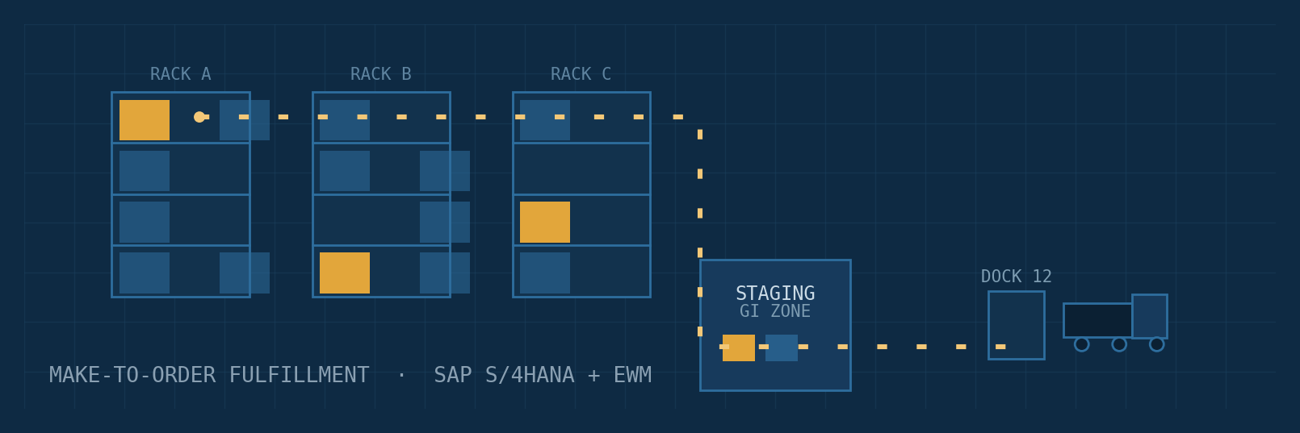
Figure 0 — A make-to-order distribution center: racked storage, a segregated pick path, staging, and dispatch.
01 · INTRODUCTION
What Make-to-Order Actually Asks of a Warehouse
Make-to-order flips the usual sequence: instead of stocking ahead of demand, production only starts once a specific customer has been committed for a shipment. That single change ripples all the way into the warehouse.\ Make-to-Order (MTO) is a fulfillment strategy where a finished good isn't built until a customer sales order calls for it. In SAP terms, this is driven by requirements strategy 20 (or a variant of it) on the material master, paired with special stock indicator E — sales-order stock. The moment a sales order is created in SD, the system generates an individual customer requirement that is kept apart from every other demand for that same material, even demand sitting in the same plant.\ That segregation is the whole point of MTO, and it's also the whole challenge. A material that's forecasted and stocked ahead of time (Make-to-Stock) can sit in any bin and satisfy any order that comes along. Sales-order stock can't. It has to be tracked, staged, produced, received, put away, picked, packed, and shipped as one continuous thread tied to one customer — and that's a job EWM is built for.

In an MTS world, the warehouse mostly moves anonymous, interchangeable stock. In MTO, every Handling Unit carries a customer's name on it, figuratively speaking. A picker cannot substitute a neighboring bin's inventory just because it's the same material — that would break the segregation the whole process depends on. This is precisely where SAP Extended Warehouse Management (EWM) earns its keep: bin-level control, Handling Unit management, and warehouse task orchestration that keep one customer's order intact through every physical touchpoint.
02 · PROCESS FLOW
The End-to-End MTO Flow, ERP to Dock Door
Eleven steps carry a single customer requirement from sales order to shipment. Each one hands a document forward to the next.
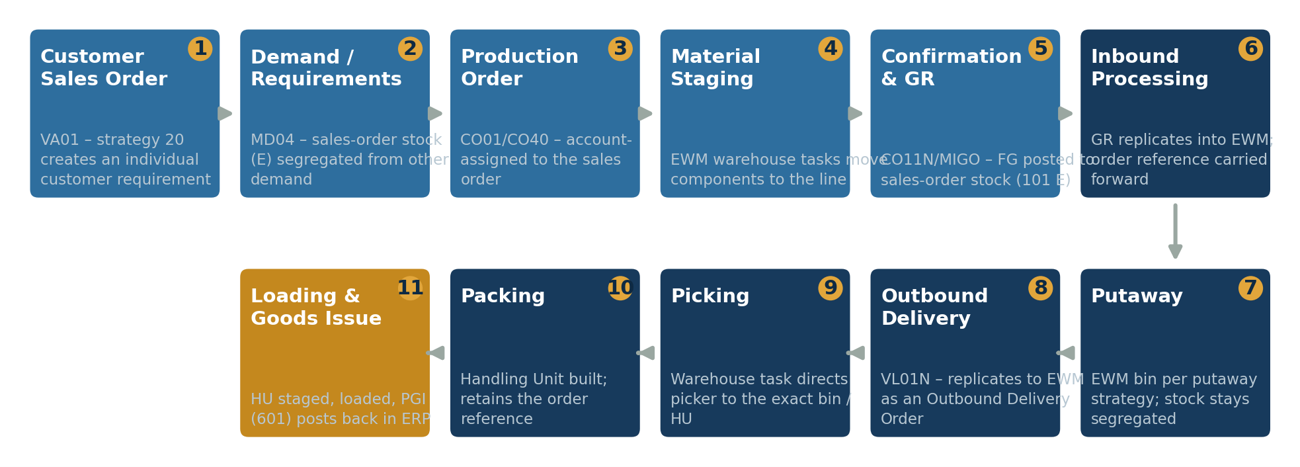
Figure 1 — End-to-end MTO process flow: ERP demand and production (top) into EWM warehouse execution (bottom).\ ▪ Sales Order (VA01) — strategy 20 creates an individual, segregated customer requirement.\ ▪ Demand / Requirements (MD04) — the sales-order-specific requirement (stock type E) appears in planning, kept apart from other demand.\ ▪ Production Order (CO01/CO40) — account-assigned to the sales order.\ ▪ Material Staging — EWM warehouse tasks move components from storage to the production supply area.\ ▪ Confirmation & GR (CO11N/MIGO) — finished product posted into sales-order stock (movement 101 E).\ ▪ Inbound Processing (EWM) — the GR replicates into EWM; the sales-order reference carries forward.\ ▪ Putaway — EWM proposes a bin per the putaway strategy, keeping order-specific stock segregated.\ ▪ Outbound Delivery (VL01N) — replicates into EWM as an Outbound Delivery Order (ODO).\ ▪ Picking — a warehouse task directs the operator to the exact bin/HU holding this order's stock.\ ▪ Packing — picked material is built into a Handling Unit that retains the order reference.\ ▪ Loading & Goods Issue — HUs staged, loaded, and EWM's goods issue posts PGI (movement 601) back in ERP.
03 · SYSTEM ARCHITECTURE
How S/4HANA, SD, PP and EWM Fit Together
MTO is a cross-module story. SD captures the demand, PP plans and executes production, and EWM owns everything that happens on the warehouse floor — all inside one SAP S/4HANA system when EWM is embedded.
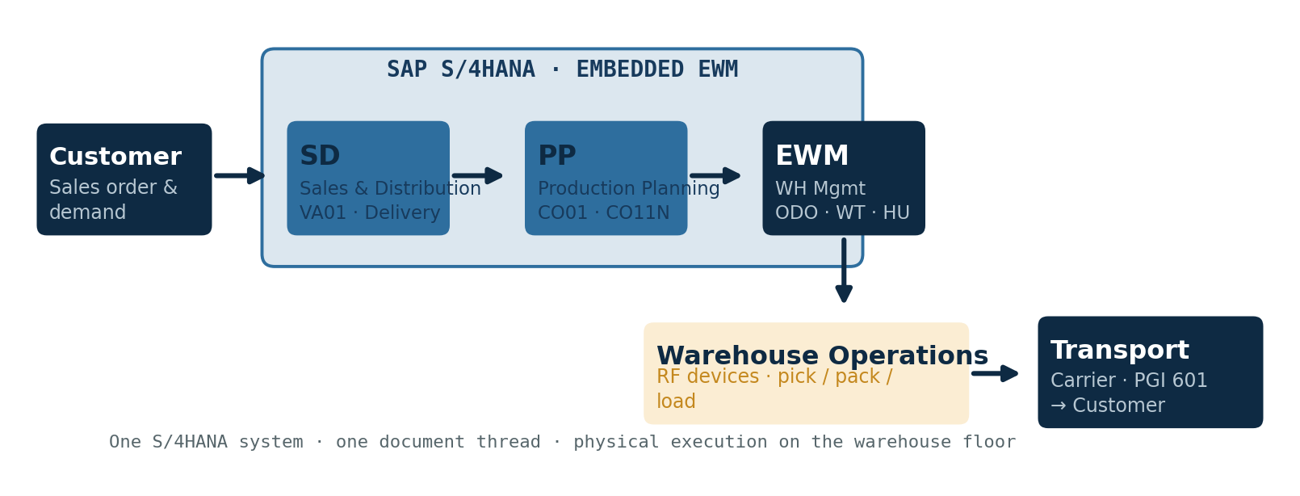
Figure 2 — S/4HANA · SD / PP / EWM integration architecture, from customer demand to transportation.\ In an embedded EWM landscape, SD, PP and EWM run on the same S/4HANA instance and share the same database, which is why documents (sales order, production order, delivery) flow into warehouse execution without a system-to-system interface delay. Warehouse execution itself — the RF devices, the pickers, the forklifts — happens outside the software boundary, on the physical floor, and connects back through Warehouse Tasks and Warehouse Orders. Transportation and the customer sit at the very end of the chain, receiving the Handling Units that EWM tracked all the way from putaway to the truck.
04 · WAREHOUSE VIEW
The MTO Process, Seen from the Warehouse
Strip away the ERP document names and the same journey reads as seven physical moves: Sales Order → Production → Goods Receipt → EWM Putaway → Pick → Pack → Ship. Every one of those seven words in Figure 1 above hides a specific SAP transaction and a specific EWM document — but the physical shape of the process never gets more complicated than this.
05 · COMPONENT STAGING
Getting the Right Parts to the Line, on Time
Staging is where warehouse execution first touches production. When a production order is released, its component list becomes demand for a staging area next to the work center. EWM generates Warehouse Tasks that move the required quantities from storage bins to that staging location, ahead of the scheduled production start — timed so the line never waits, but stock doesn't pile up early either.
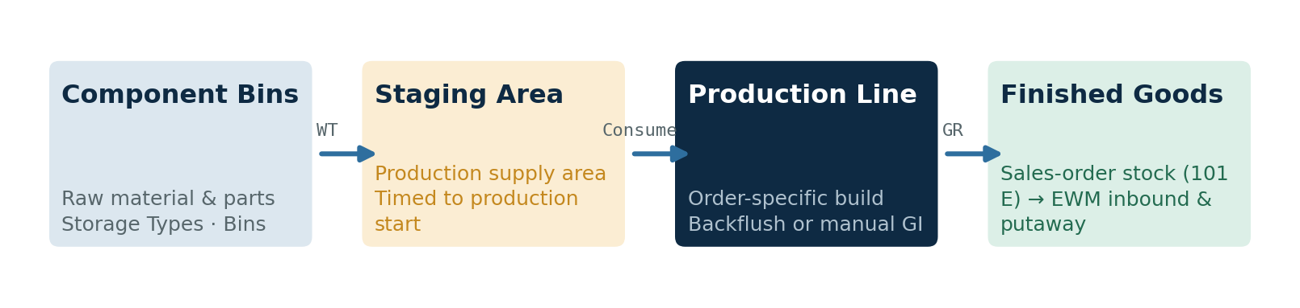
Figure 3 — Component staging to finished-goods receipt.\ Consumption can be handled in two ways: a manual goods issue against the production order, or backflushing, where components are automatically consumed at confirmation based on the bill of materials. Either way, EWM keeps the staging area, the bins, and the production supply area reconciled in real time, so what the system thinks is on the line matches what's actually there.
06 · FINISHED GOODS RECEIPT
From the Production Line into EWM
The finished product's journey into the warehouse mirrors any other goods receipt — with one difference: it never loses its customer tag. When production confirms the last operation, the Goods Receipt posts the finished material into sales-order stock (movement type 101, special stock indicator E). That GR immediately replicates into EWM, which creates the inbound delivery and a Warehouse Task for putaway.\ Bin determination follows the putaway strategy configured for the storage type — but because the stock carries the sales-order reference, EWM keeps it out of bins used for general or forecasted inventory, even when the exact same material exists elsewhere in the warehouse under different stock ownership. Once the task is confirmed, the finished good is on the shelf, reserved, and ready to be picked the moment the outbound delivery calls for it.
07 · OUTBOUND PROCESS
**Turning the Sales Order into a Shipment**
Outbound processing begins the moment a delivery is created against the original sales order. That delivery replicates into EWM as an Outbound Delivery Order (ODO), which becomes the trigger for every downstream warehouse activity:\ ▪ Warehouse Order / Task creation — EWM generates the tasks needed to fulfill the ODO, restricted to bins holding this order's segregated stock.\ ▪ Picking — confirmed via RF or desktop, closing out the warehouse task as stock leaves the storage bin.\ ▪ Packing — picked material is built into a Handling Unit at a pack station, retaining full traceability back to the sales order.\ ▪ Loading — HUs are staged and loaded at the assigned dock door, following the warehouse's yard and dock scheduling.\ ▪ Post Goods Issue — EWM posts the goods issue, which triggers PGI (movement 601) back in ERP, closing the loop on the delivery and enabling billing.
08 · EWM CAPABILITIES
What Makes EWM the Right Engine for This
A handful of core EWM capabilities are doing the heavy lifting throughout the process above.
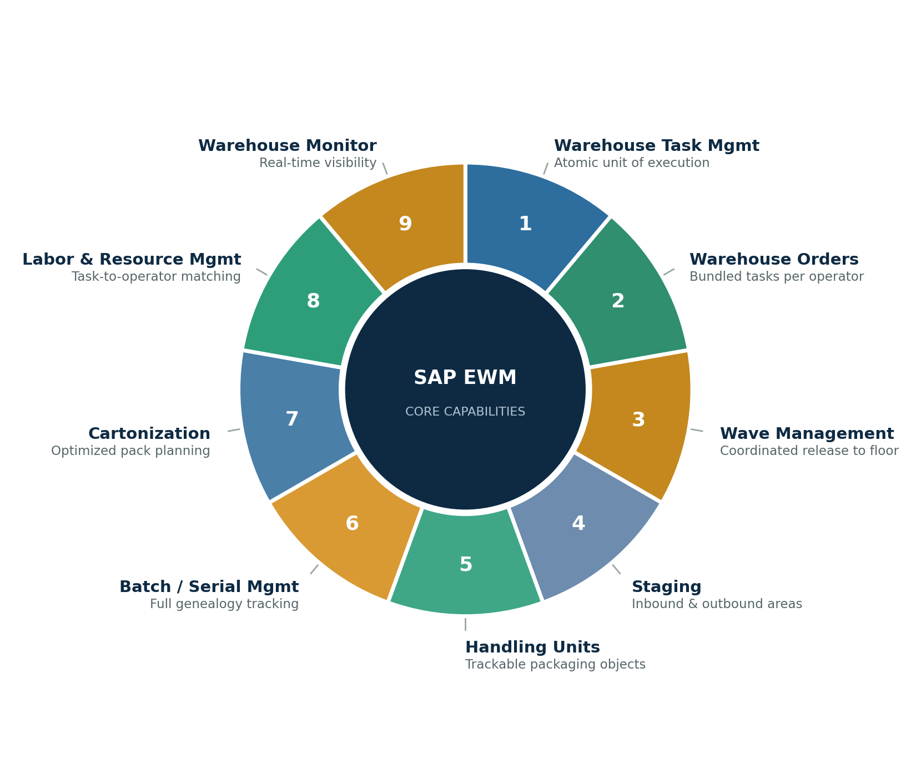
Figure 4 — Core SAP EWM capabilities supporting an MTO operation.\ ▪ Warehouse Task Management — the atomic unit of execution; every move, pick, and putaway is tracked to completion.\ ▪ Warehouse Orders — groups of tasks bundled for a single operator, balancing travel distance and workload.\ ▪ Wave Management — releases deliveries to the warehouse floor in coordinated batches, timed to shipping schedules.\ ▪ Staging — dedicated areas and logic for both inbound-to-production and outbound-to-dock movements.\ ▪ Handling Units — nested, trackable packaging objects that carry stock, and its order reference, through every move.\ ▪ Batch / Serial Management — full genealogy tracking for regulated, configurable, or serviceable products.\ ▪ Cartonization — optimized pack planning where products ship in cartons or mixed-SKU containers.\ ▪ Labor & Resource Management — matches tasks to available operators and equipment against engineered standards.\ ▪ Warehouse Monitor — real-time, role-based visibility into every open task, exception, and order status on the floor.
09 · BUSINESS BENEFITS
What This Integration Delivers
None of this complexity is worth it unless it shows up in outcomes the business actually feels.
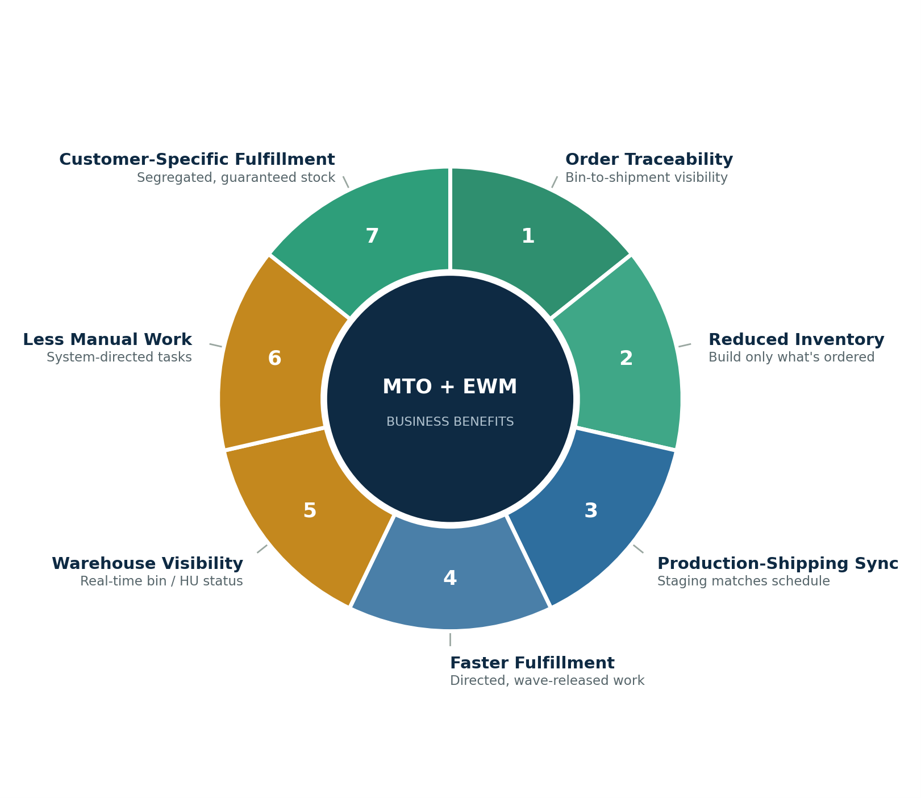
Figure 5 — Business benefits of running MTO on SAP S/4HANA + EWM.\ ▪ Order Traceability — every unit stays visibly linked to its originating sales order from staging through shipment.\ ▪ Reduced Inventory — building only what's ordered avoids speculative stock and its carrying cost.\ ▪ Production-to-Shipping Coordination — staging, GR, and outbound execution stay synchronized to the production schedule automatically.\ ▪ Faster Fulfillment — directed tasks and wave-released work reduce idle time between production and dispatch.\ ▪ Warehouse Visibility — bin- and HU-level status is visible in real time, not discovered at cycle count.\ ▪ Less Manual Intervention — system-directed tasks replace paper pick lists and ad hoc warehouse decisions.\ ▪ Customer-Specific Fulfillment — segregated stock guarantees the exact configuration a customer ordered is what actually ships.
\ 10 · REAL-WORLD EXAMPLE
A Day in the Life: Industrial Equipment Manufacturing
CASE SKETCH · INDUSTRIAL MANUFACTURER
A customized hydraulic pump, built to spec
An industrial equipment manufacturer sells hydraulic pump units where flow rate, port configuration, and control electronics vary by customer. A distributor places a sales order for 12 units in a specific configuration that isn't held in stock anywhere in the network.\ The sales order creates a segregated requirement; production plans and builds exactly those 12 units against that order. As each unit clears final test, GR posts it into sales-order stock, and EWM puts it away in a bin reserved for this shipment — physically separated from standard-configuration pumps sitting two aisles over. When the outbound delivery releases, EWM directs pickers straight to those bins, packs the units into labeled Handling Units, stages them at the assigned dock, and posts the goods issue the moment the truck is loaded. The distributor receives exactly the 12 units it ordered, and every one of them can be traced back to the order that created it.
11 · MTO VS. MTS
Two Strategies, Two Warehouse Postures
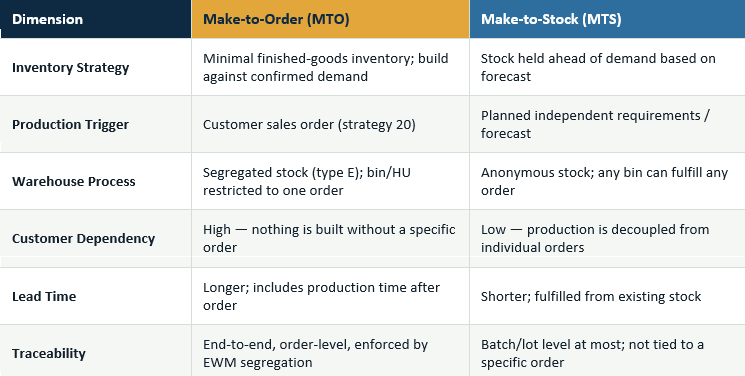
Neither approach is universally better — they answer different questions about how much you can predict versus how customer-specific your product needs to be.
12 · KEY TAKEAWAYS
Why This Integration Matters
- 1) MTO lives or dies on segregation — special stock indicator E is only meaningful if the warehouse actually enforces it — which is EWM's job, not ERP's alone. - 2) Embedded EWM removes the interface risk — running SD, PP, and EWM on one S/4HANA instance means the document chain from sales order to Handling Unit never crosses a system boundary. - 3) Staging accuracy protects the production schedule — Warehouse Tasks timed to the production order keep the line fed without excess work-in-process. - 4) Putaway discipline is what makes picking trustworthy — if segregated stock isn't binned correctly on receipt, no amount of picking logic downstream can fix it. - 5) Warehouse Orders and Wave Management turn individual tasks into a manageable operation — without them, MTO's one-order-at-a-time nature could overwhelm a warehouse floor. - 6) The Warehouse Monitor is the operational nerve center — real-time visibility into task status is what lets supervisors intervene before a delay becomes a missed ship date. - 7) Traceability isn't a reporting feature — it's the product — for configurable, engineered, or customer-specific goods, being able to prove exactly what shipped and where it came from is often as valuable as the item itself. -
SAP S/4HANA · SD · PP · EWM — Make-to-Order Fulfillment, Explained