
Ask ten SAP delivery leads how much of their test suite is automated, and you'll get a confident number. Ask them how much of it they'd bet a go-live on, and the room goes quiet. SAP testing is changing shape faster than most delivery teams have adjusted for. The goal was never to automate as many test cases as possible — it's to build a confident, automated suite that proves your business processes work end-to-end, not just that individual screens and transactions function in isolation. That distinction is what separates the SAP programs that scale in 2026 from the ones that stall.
Script counts are a vanity metric. The number that indicates success is how much of your business process footprint — order to cash, procure to pay, record to report — is automated and trusted enough to run unattended. A team can automate a thousand scripts and still be blind to the process risk that matters; a team with a fraction of that count, mapped to the right end-to-end flows, can run releases with real confidence.
Three shifts are shaping how leading SAP organizations approach quality this year. Here's what we're seeing across our Testing Center of Excellence (TCoE) engagements, and what it means for your next release.
1. Maintainable beats massive
For a decade, test automation was scored on coverage percentage. That math is breaking down. Every S/4HANA release, Fiori update, or integration change forces a rewrite of brittle, UI-dependent scripts — and teams that automated everything are now the ones spending the most time on upkeep, not testing. The shift we're advising clients toward: fewer, sturdier tests built around actual business processes rather than isolated transaction steps, with self-healing automation absorbing UI drift instead of breaking on it. It's a smaller suite that survives your next upgrade.
2. Agentic AI enters the test cycle
This is the trend that will define the next two years. SAP is embedding AI agents directly into transactional workflows — approvals, exception handling, demand planning recommendations. That changes what "testing" means. You're no longer just validating that a deterministic transaction posts correctly; you're validating that an AI-driven decision was reasonable, explainable, and safe to act on.
Tooling is catching up. GenAI-driven authoring, intelligent test scoping that flags which scenarios actually need re-testing after a configuration change, and natural-language test creation are moving from pilot to production inside platforms like Tricentis Tosca and Testim. The organizations ahead of this curve are treating AI-agent testing as its own discipline, not a bolt-on to existing regression packs.
3. Continuous testing becomes the default, not the differentiator
S/4HANA Cloud's release cadence removed the option of testing in long, quiet windows between go-lives. Every quarterly update, every integration change, needs validation on a clock. Manual testing alone cannot keep pace with that cadence — it's no longer a maturity nice-to-have, it's the baseline requirement for staying on a supported, current release. That's pushing CI/CD-integrated testing, cloud-based performance testing, and upgrade impact analysis (tools like LiveCompare) from "advanced practice" to "table stakes" for any organization serious about S/4HANA.
“Just as every bolt and gear must be scrutinized to ensure peak performance and safety, thorough testing ensures that every component of the software operates flawlessly.” — Mygo's philosophy toward testing
What this looks like in practice
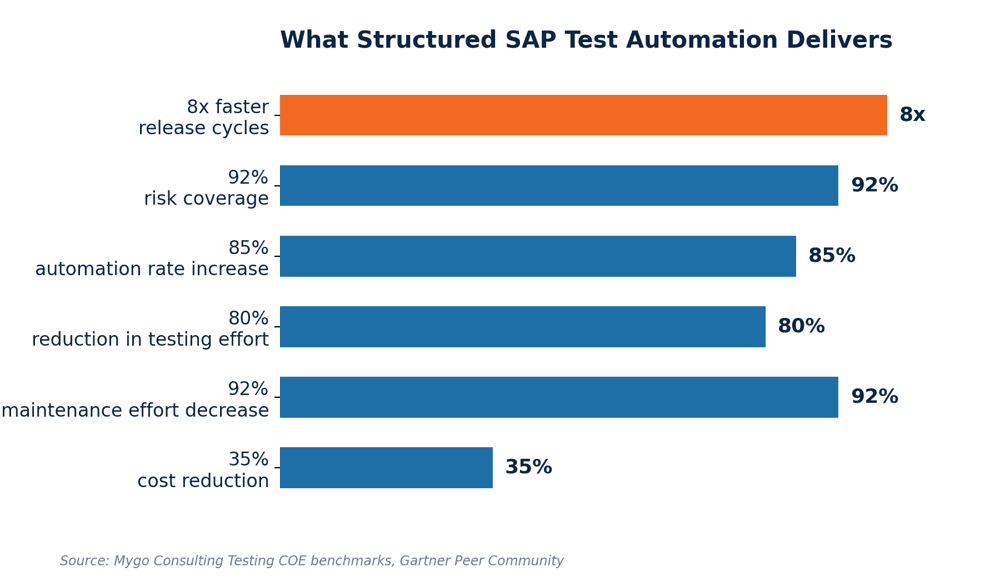
Across our TCoE engagements — spanning retail, life sciences, energy, and industrial clients — the numbers back up the shift. Structured, well-governed automation (not just "more" automation) is what moves the needle:
We're seeing this play out directly in client work: end-to-end S/4HANA retail test automation with performance testing at scale for a grocery retailer, weekly regression automation keeping a home furnishings client's SAP operations steady, and upgrade-testing strategy work supporting a pharmaceutical client's S/4HANA 2025 migration. Different industries, same underlying discipline — automation that's governed, scoped, and built to last.
If your team is still measuring testing success by script count instead of release confidence, it's worth a conversation.
Talk to our Testing COE